
10 Best AI Tools for Students
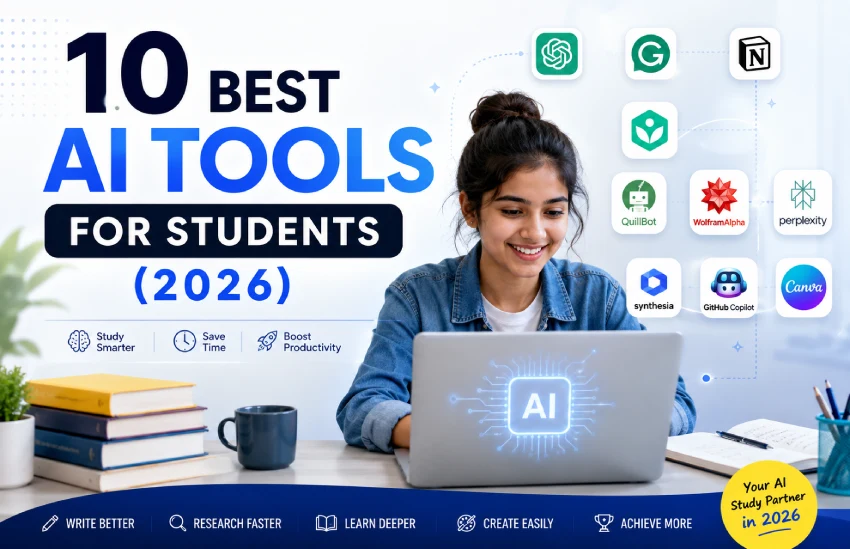
10 Best AI Tools for Students
AI is no longer a buzzword – it is a daily study partner for millions of students worldwide. From drafting research papers to cracking complex math problems, the right AI tool can cut hours of work into minutes. But with hundreds of options flooding the market in 2026, choosing the best one can feel overwhelming.
At WEBOPTECH, we work closely with digital tools every day – including AI video generators, content platforms, and productivity software. Based on that hands-on experience, we have shortlisted the 10 best AI tools for students in 2026 that actually deliver results in academics, creativity, and career growth.
Whether you are a school student, an undergrad, or a postgraduate researcher, this guide is designed to help you work smarter – not harder.
| Note | This list covers tools tested across content creation, research, coding, writing, and learning. Each tool below is selected based on real-world usability, student-specific features, and value for money. |
|---|
1. Chat GPT (Open AI) – Best for Writing and Research Assistance
ChatGPT remains the most widely used AI tool for students in 2026. Whether you need to summarise a 50-page research paper, brainstorm essay ideas, or write a cover letter for an internship, ChatGPT handles it all within seconds.
Why students love it:
- Generates well-structured essays and reports
- Explains complex topics in simple language
- Supports 50+ languages – ideal for international students
- GPT-4o model handles text, image, and voice inputs
Best for: Essay writing, concept explanation, research summaries, and coding help.
2. Grammarly – Best for Writing Accuracy and Style
Every student who writes assignments, emails, or thesis papers needs Grammarly. It goes beyond basic spell-check – it analyses tone, clarity, and even plagiarism, making your academic writing stronger and more professional.
Key features for students:
- Real-time grammar and punctuation corrections
- Tone detection – formal, academic, or casual
- Plagiarism checker with citation suggestions
- Seamless integration with Google Docs, MS Word, and browsers
Best for: Assignment submissions, academic papers, emails to professors, and LinkedIn profiles.
3. Notion AI – Best for Study Planning and Note-Taking
Notion AI upgrades your note-taking game from passive to active. Students can summarise lecture notes, generate to-do lists, build study schedules, and even draft project proposals – all inside one workspace.
Top student benefits:
- AI-powered summarisation of lengthy notes
- Auto-generates action items from meetings or group discussions
- Custom templates for study plans, project tracking, and flashcards
- Collaborative features for group projects
Best for: Study organisation, group projects, research documentation, and semester planning.
4. Khanmigo by Khan Academy – Best for Personalised Learning
Khanmigo is an AI tutor built specifically for students. Unlike general-purpose AI, it does not give away answers directly – instead, it guides students through problems using the Socratic method, building real understanding and critical thinking.
What makes it unique:
- Subject-specific tutoring across maths, science, humanities, and coding
- Encourages problem-solving rather than answer-giving
- Tracks learning progress and adapts difficulty
- Safe and student-focused interface
Best for: School students, exam preparation, and subject-specific learning support.
5. Quillbot – Best for Paraphrasing and Academic Integrity
Quillbot is a lifesaver when students want to rewrite content without losing the original meaning. It helps rephrase paragraphs, fix passive voice, and maintain a consistent academic tone – making it perfect for term papers and theses.
Features students rely on:
- Seven paraphrasing modes – Standard, Fluency, Formal, Creative, and more
- Built-in grammar checker and summariser
- Word flipper to vary vocabulary naturally
- Co-Writer feature for drafting long-form content
Best for: Research paraphrasing, thesis writing, literature reviews, and content rephrasing.
6. Wolfram Alpha – Best for Maths and Science Problem-Solving
Wolfram Alpha is the go-to AI tool for STEM students. It solves complex equations, explains step-by-step solutions, and handles everything from calculus to chemistry – making it an indispensable resource for science and engineering students.
Standout capabilities:
- Step-by-step solutions for algebra, calculus, and statistics
- Data computation and visualisation
- Chemistry balancing, physics formulas, and biology diagrams
- Integrated with ChatGPT Plus for conversational maths
Best for: STEM students, competitive exam prep, and technical problem-solving.
7. Perplexity AI – Best for Research and Fact-Checked Answers
Unlike ChatGPT, Perplexity AI searches the live web and provides cited, source-backed answers. For students who need real-time data, academic sources, and reliable research, Perplexity is a huge upgrade over standard search engines.
Research-focused highlights:
- Every answer comes with cited sources for verification
- Supports academic mode with peer-reviewed sources
- Real-time web access – no outdated training data
- Follow-up question feature for deeper research sessions
Best for: Research papers, academic fact-checking, literature searches, and citation building.
8. Synthesia – Best for AI Video Presentations
As someone who works in AI video generation professionally, I can say Synthesia is one of the most powerful tools for creating educational and presentation videos. Students no longer need cameras or editing skills – just a script
Why Synthesia stands out:
- 120+ AI avatars – professional and diverse
- Text-to-video in minutes – ideal for class presentations
- Supports 140+ languages – great for international students
- Custom branding and slide integration
Best for: Class presentations, e-learning projects, YouTube channels, and digital portfolios.
9. GitHub Copilot – Best for Coding and Computer Science Students
For students studying computer science, software development, or data science, GitHub Copilot is the ultimate AI coding assistant. It auto-completes code, suggests entire functions, and helps debug errors in real-time – cutting development time by up to 55%.
Key coding benefits:
- Supports Python, JavaScript, Java, C++, and 30+ languages
- Context-aware code suggestions and completions
- Explains code logic in plain English
- Free for students via GitHub Education Pack
Best for: Computer science assignments, hackathons, app development, and programming practice.
10. Canva AI – Best for Design and Visual Projects
Canva has always been a student favourite, and its AI features in 2026 – Magic Write, Magic Design, and AI image generation – make it an even more powerful creative platform. Students can design infographics, presentations, posters, and social media visuals without any design background.
AI-powered design features:
- Magic Write – AI text generator for captions and content
- Magic Design – generates slide decks from a simple prompt
- Text-to-image generator for custom visuals
- Resize designs instantly for any platform or format
Best for: Project presentations, infographic creation, event posters, and social media content.
| 💡 Pro Tip from WEBOPTECH | Do not try to master all 10 tools at once.Pick 2-3 that align with your course, your goals, and your daily workflow. The best AI tool is the one you actually use consistently — not the most advanced one. |
|---|
Quick Comparison: AI Tools at a Glance
|
Final Thoughts – Choosing the Right AI Tool
The AI tools landscape changes fast – but the fundamentals of good learning do not. These 10 tools are not shortcuts; they are force multipliers. Used correctly, they help students research faster, write better, learn deeper, and produce higher-quality work.
At WEBOPTECH, we believe the smartest students in 2026 will not be the ones who avoid AI – they will be the ones who know which AI tool to use, when, and why.
Start with one tool this week. Master it. Then build your AI-powered student toolkit from there.