Google Ads vs Meta Ads: Which is Better for Your Hospital or Clinic in 2026?
Google Ads vs Meta Ads: Which is Better for Your Hospital or Clinic in 2026?
If you run a hospital, clinic, or healthcare practice, you already know the pressure: more patients are searching for care online than ever before. But here is the real question every healthcare marketer is wrestling with in 2026 – should you invest your advertising budget in Google Ads vs Meta Ads (Facebook & Instagram)? Or is the answer a smarter combination of both?
At WEBOPTECH, we work with healthcare providers across India and beyond, and this is one of the most common – and most important – questions we hear. This guide breaks it all down in a way that is honest, practical, and grounded in what actually works for hospitals and clinics today.
Why Healthcare Marketing Is Different
Before we compare the two platforms, let us acknowledge something important: healthcare is not a typical industry. You are not selling shoes or software. You are earning the trust of people who are anxious, unwell, or making decisions on behalf of someone they love. Every ad you run, every word you choose, reflects your clinic’s values and your commitment to patient care.
This means your advertising strategy must balance two things: being visible when patients need you most and building the kind of trust that converts a click into a consultation booking.
Both Google Ads and Meta Ads can help you achieve this – but in very different ways. If you are not sure whether your current digital strategy is working at all, we recommend first reading our breakdown of the top digital marketing mistakes costing healthcare practices – it is a helpful starting point before investing further in paid ads.
Google Ads for Hospitals and Clinics: Capturing Intent
Google Search Ads operate on a simple but powerful principle: someone types “best orthopaedic clinic near me” or “diabetes specialist in Bhubaneswar” and your ad appears right at the top of the results. That person is already looking for help. They have intent. They are ready to act.
When Google Ads Works Best for Healthcare:
- Promoting specific services: cardiology consultations, physiotherapy, diagnostic packages, and dental procedures.
- Capturing urgent care searches: emergency services, 24/7 clinics, same-day appointments.
- Local search visibility: appearing when patients search for care in your city or neighbourhood. This works even better when your clinic is properly listed and optimised on Google Maps – the two together create a powerful local presence.
- Driving immediate appointment bookings, especially for high-value treatments.
Google Ads also gives you powerful targeting through Google Display and Performance Max campaigns, allowing you to stay visible across Gmail, YouTube, and thousands of health-related websites – keeping your clinic top-of-mind throughout the patient’s decision journey.
Many clinic owners overlook that Google requires advertiser identity verification before ads can go live, especially in healthcare. Setting this up correctly helps avoid delays and disapprovals.
Also, Google Ads and SEO work best together, not separately. If you’re deciding where to start, our comparison of SEO vs Google Ads for faster results gives a clear breakdown to help you use your budget wisely.
| The honest reality: Google Ads can be more expensive per click in healthcare, especially for competitive specialties. But the quality of that traffic – people actively searching for the exact care you provide – often makes the investment worthwhile. |
Meta Ads for Hospitals and Clinics: Building Awareness and Trust
Meta Ads (running across Facebook and Instagram) work differently. Rather than catching someone mid-search, they reach people as they scroll through their daily feed. This is an interruption-based model – which, in healthcare, is not a weakness. It is actually a strategic strength when used correctly.
Think about it this way: not every patient knows they need a health check-up. Someone scrolling Instagram at 8 PM may not have searched for “cardiac screening” yet – but a well-crafted ad about heart health awareness might prompt them to book one. That is the power of Meta Ads: they create demand before the patient even realises they have one.
When Meta Ads Works Best for Healthcare:
- Preventive care campaigns: health screenings, vaccination drives, annual wellness packages.
- Brand storytelling: sharing patient success stories and social proof (with consent), introducing your specialist team, building community trust.
- Hyper-local targeting: reaching specific demographics, age groups, or localities around your clinic.
- Retargeting: re-engaging people who visited your website or interacted with your content but did not book.
Meta Ads typically offer a lower cost-per-impression, making them excellent for awareness campaigns and building the long-term reputation your clinic needs. In 2026, with short-form video ads on Instagram Reels and Facebook Stories, healthcare providers will have more engaging, less clinical formats to connect with patients on a human level.
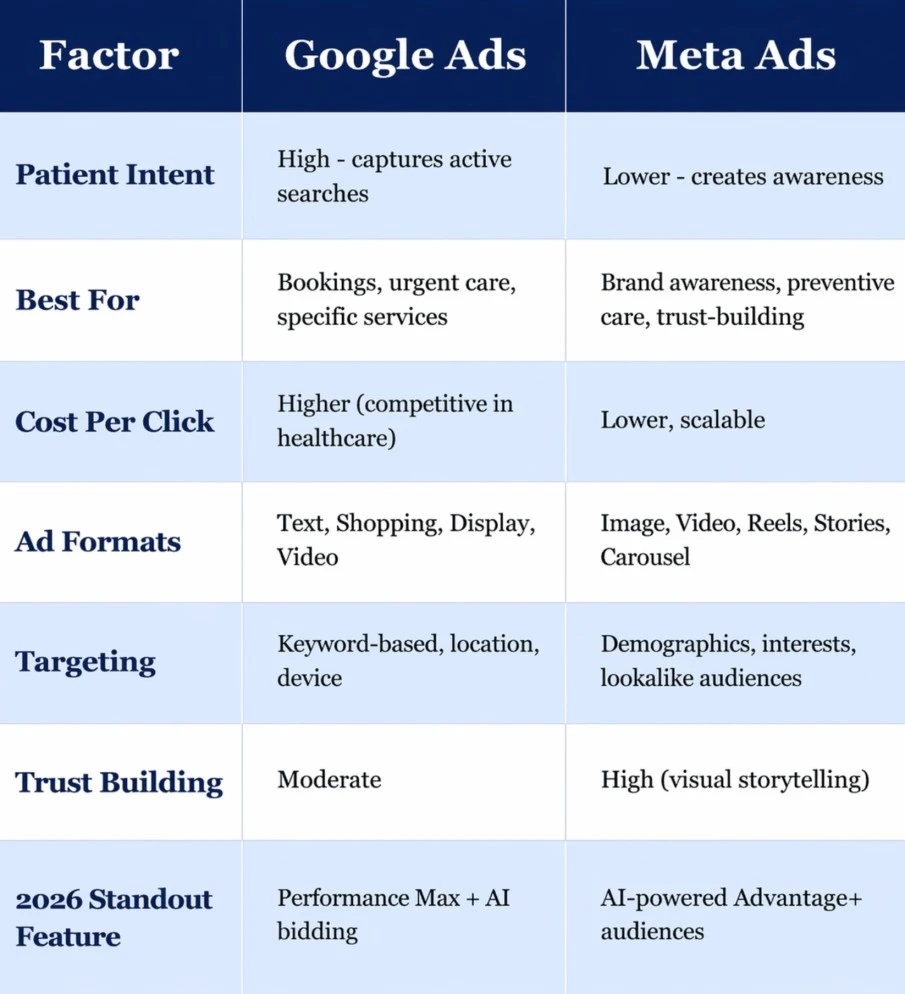
Head-to-Head Comparison: Google Ads vs Meta Ads for Healthcare
The 2026 Reality: Why Healthcare Needs Both
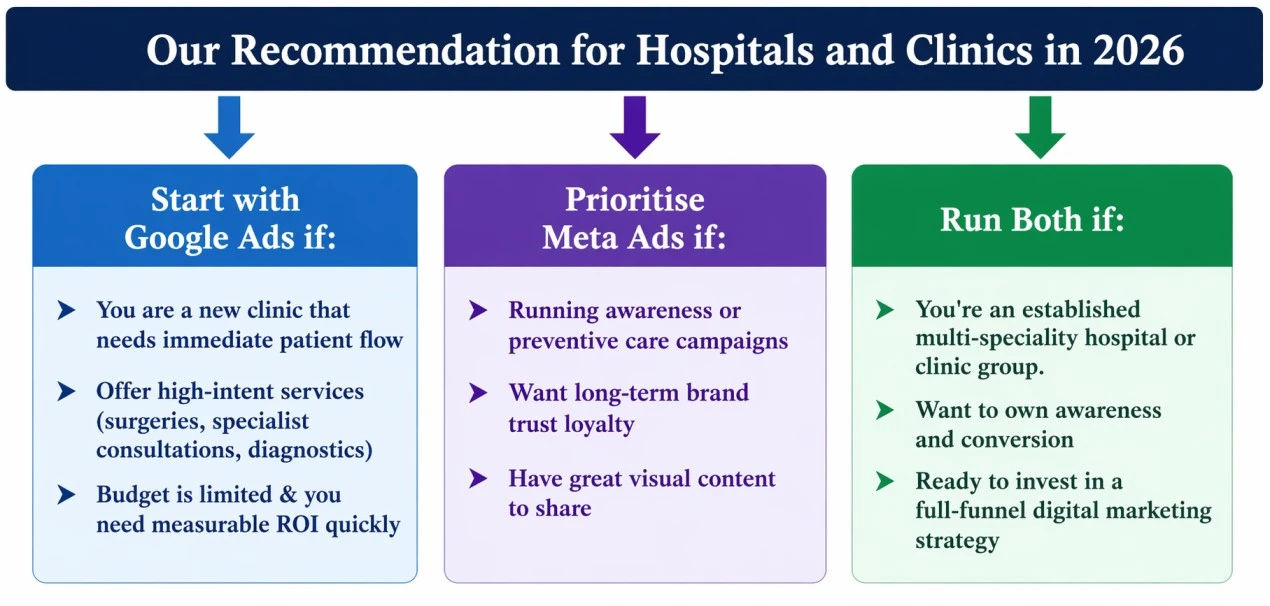
Here is what years of running healthcare ad campaigns have taught us: the most successful clinics do not choose between Google Ads and Meta Ads. They use both in a coordinated way.
- Two-stage patient journey:
A patient first discovers your clinic through a Facebook video (e.g., about managing diabetes). Later, when symptoms worsen, they search “diabetes specialist near me” on Google and find your ad. The second touchpoint converts because the first one already built trust. - Smarter integration with AI tools (2026):
Google’s Performance Max runs ads across Search, Display, YouTube, and Gmail, while Meta’s Advantage+ optimizes placements in real time. When messaging is consistent across both platforms, it creates a smooth journey from awareness to appointment booking. - Your website still matters most:
If traffic is coming but appointments aren’t converting, your landing page may be the issue. Ensure your website is built for mobile-first patient experience – because most healthcare searches in 2026 happen on smartphones, and a poor experience can waste your ad spend.
Healthcare Advertising Compliance: What You Must Know
Both Google and Meta have strict advertising policies for healthcare content. In India, the Central Consumer Protection Authority (CCPA) guidelines and AYUSH regulations further shape what healthcare providers can and cannot claim in ads. Here are the non-negotiables:
- Never make unqualified medical claims or guaranteed cure statements.
- Always include appropriate disclaimers on before/after content.
- Obtain informed consent before using patient testimonials in any ad format.
- Avoid targeting based on sensitive health conditions on Meta (their policy prohibits this).
Working with a specialised healthcare digital marketing agency – one that understands both the platforms and the regulatory landscape – is not just helpful. It is essential to protecting your clinic’s reputation and avoiding costly ad disapprovals.
Frequently Asked Questions (FAQs)
1. Is Meta better than Google Ads?
If your goal is immediate lead generation, Google Ads may be the better option. If your goal is awareness or education, Meta Ads may be more effective. In many cases, the best approach is not Meta or Google, but Meta and Google working together.
Final Thoughts: The Right Platform Is the One That Serves Your Patients
At the end of the day, both Google Ads and Meta Ads are simply tools – powerful ones, but tools nonetheless. What matters is how you use them in service of the patients who need your care. In 2026, the digital landscape for healthcare has matured significantly. Patients are more informed, more discerning, and more likely to research a clinic thoroughly before booking. Your advertising must reflect that.
The clinics that will win in this environment are those that combine strategic visibility on Google with genuine trust-building on Meta – all while maintaining the highest ethical and regulatory standards.
At WEBOPTECH, we specialise in exactly this – healthcare digital marketing that is empathetic, compliant, and results-driven. Whether you are a single-specialty clinic in Bhubaneswar or a multi-speciality hospital expanding your reach, we can help you build a strategy that fills your appointment book and your patients’ trust.
Ready to grow your patient base with the right digital strategy?
Talk to the WebOpTech team today. We offer a free digital marketing audit for hospitals and clinics. Let’s build something that works – for you and for your patients.