SEO, Google Ads or Social Media: Where Should a Small Business Spend First?
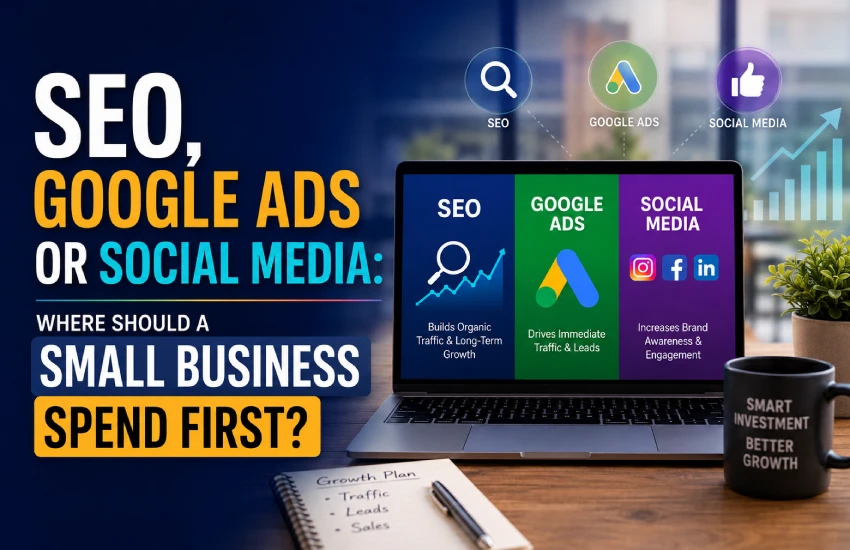
SEO, Google Ads or Social Media: Where Should a Small Business Spend First?
If you run a small business, you have probably heard the same advice over and over again.
“You need SEO.”
“You should run Google Ads.”
“You need to build your brand on social media.”
All of that sounds reasonable until you look at your marketing budget.
If you have ₹30,000, ₹50,000 or even ₹1 lakh available each month, putting money into everything at once may not be the smartest move. You need to know what is most likely to help your business right now.
The real question isn’t whether SEO, Google Ads or social media is better.
The better question is: which one should your business invest in first?
The answer depends on what you sell, how quickly you need customers, how competitive your market is, whether people are already searching for your services and how much time you can afford to wait for results.
Let’s break it down.
The Short Answer
If you need leads quickly and people are already searching for what you sell, Google Ads is often the fastest place to start.
If you want to build a steady source of organic traffic and reduce your dependence on paid advertising over time, SEO is usually the stronger long-term investment.
If your business depends heavily on visual content, recommendations, brand awareness or customer engagement, social media can be extremely valuable, particularly when combined with paid social advertising.
For many businesses, the smartest strategy isn’t choosing one forever.
It is choosing the right starting point and then adding the other channels as the business grows.
Start With the Customer, Not the Marketing Channel
One of the biggest mistakes small-business owners make is choosing a marketing channel before understanding how customers actually find them.
Think about a person who needs an emergency plumber.
They are unlikely to spend three weeks following plumbing companies on Instagram before making a decision. They are probably going to search Google, compare a few businesses, check reviews and call someone.
Now consider someone planning a holiday to Dubai.
They might discover a travel company through Instagram or YouTube, watch videos, compare destinations, search Google later and eventually make a booking.
The buying journey is different.
That is why the right marketing channel depends heavily on customer behavior.
Before spending money, ask:
Where does my customer go when they have a problem I can solve?
That question will tell you much more than a generic list of “best digital marketing channels.”
When Google Ads Should Come First
Google Ads can make sense when customers already have a strong reason to search for your product or service.
Someone searching for:
“dentist near me”
“emergency electrician”
“Dubai desert safari price”
“AC repair near me”
“digital marketing agency in Bhubaneswar”
is already expressing some level of intent.
That makes search advertising particularly useful for businesses selling services where the customer is actively looking for a solution.
WebOpTech’s Google Ads services focus on search, display, shopping and video advertising, with campaign strategies built around business goals such as leads, sales and enquiries.
Google Ads can be a good first investment when:
- You need leads relatively quickly
- Customers already search for your services
- Your average customer value is high enough to support paid acquisition
- You have a landing page that can convert visitors
- You can track calls, forms, purchases or other meaningful conversions
- You are operating in a competitive local market
- You have a time-sensitive offer or seasonal demand
But there is an important warning.
Google Ads can bring traffic quickly. It cannot fix a bad offer, poor website or weak sales process.
If ten people click your advertisement and nobody contacts you, increasing the budget isn’t necessarily the answer.
You first need to understand why those visitors aren’t converting.
A simple example
Suppose a local dental clinic spends ₹1,000 per day on Google Ads.
If the ads generate calls from people looking for dental treatment, the campaign may be doing its job.
But if the website is slow, the phone number is difficult to find, the landing page doesn’t explain the treatment or nobody answers incoming calls, more advertising won’t solve the underlying problem.
The marketing funnel has several parts.
Search → Click → Website → Enquiry → Follow-up → Patient
A problem anywhere along that path can reduce the final result.
When SEO Should Come First
SEO is a different game.
You don’t normally invest in SEO because you need a large number of customers tomorrow morning.
You invest because you want your business to become easier to find when potential customers search for relevant products and services over the long term.
A strong SEO strategy can involve technical improvements, content, local SEO, internal linking, authority building, keyword research and improvements to the overall website experience.
For a local business, it can also involve improving visibility across Google Search and local results.
SEO can make sense as your first priority when:
- Your customers regularly use Google to research your services
- You want to build long-term organic visibility
- You don’t want every lead to depend on advertising spend
- Your competitors already dominate organic search
- You have useful expertise that can be turned into content
- You can wait for results to develop
- Your website needs stronger organic visibility
The biggest misunderstanding about SEO is that it is simply about putting keywords on pages.
It isn’t.
A good SEO strategy should help search engines understand what your business offers while also making your website genuinely useful to people.
That distinction becomes even more important as search increasingly includes AI-generated answers and conversational search experiences.
The catch with SEO
SEO takes time.
How much time depends on the website, competition, location, industry, content quality, technical condition and authority of the domain.
That means SEO can be a poor choice if your business needs leads immediately and has no existing search visibility.
In that situation, paid search may provide a useful bridge while your organic presence is being developed.
When Social Media Should Come First
Social media works differently from both SEO and Google Search Ads.
People usually aren’t opening Instagram because they urgently need a product.
They are there to watch something interesting, learn something, follow people, discover brands or simply pass time.
That changes the marketing approach.
A good social media strategy is often about creating demand rather than simply capturing existing demand.
For example, someone may not wake up thinking:
“I need to buy a new sofa today.”
But they might see an impressive home-interior video, become interested in a particular style, visit the business profile and eventually enquire.
This is where social media marketing can become valuable.
Social media may deserve priority when:
- Your product is highly visual
- Your customers spend significant time on social platforms
- Your business benefits from demonstrations or videos
- Brand awareness is important
- Your buying cycle involves discovery and consideration
- You have strong stories, expertise or educational content to share
- Recommendations and social proof influence buying decisions
Restaurants, fashion brands, travel companies, beauty businesses, fitness brands, home-interior companies and many consumer businesses can benefit strongly from this approach.
But there is another misconception worth addressing.
Posting regularly is not the same thing as having a social media strategy.
A business can post five times a week and still generate almost no business from social media.
The important question is not:
“How often are we posting?”
It is:
“What is each piece of content supposed to accomplish?”
SEO vs Google Ads vs Social Media
Here is a simpler way to think about the three.
| Marketing Channel | Best At | Main Advantage | Main Limitation |
|---|---|---|---|
| SEO | Capturing existing search demand | Builds long-term visibility | Takes time |
| Google Ads | Capturing high-intent searches | Can generate visibility quickly | Requires ongoing budget |
| Social Media | Creating awareness and demand | Builds relationships and brand familiarity | Organic reach can be unpredictable |
None of these is automatically the winner.
The winner depends on your customer journey.
What Should a New Business Do?
Let’s say you’ve just launched a new business.
Your website is new.
Nobody knows your brand.
You have limited organic visibility.
You need your first customers.
In that situation, waiting for SEO alone may not be practical.
A small, carefully controlled Google Ads campaign can help you test whether people are searching for your service and whether your offer converts.
At the same time, you can begin building your SEO foundation.
Social media can support the process by giving people another place to learn about your business and decide whether they trust you.
The important word here is test.
Don’t immediately spend your entire marketing budget.
Start small, measure what happens and put more money into the channel that demonstrates genuine business value.
What If Your Business Has a Very Limited Budget?
This is where things get more interesting.
Suppose you have ₹20,000 per month.
You could divide it equally between SEO, Google Ads and social media.
That sounds balanced.
It may also be a mistake.
Three small budgets can sometimes produce three weak campaigns.
Instead, identify the channel closest to revenue.
For example:
Local service business
A plumber, dentist, lawyer, electrician or repair company may benefit from prioritizing Google Search Ads and local SEO.
Travel business
A tour operator may need a combination of SEO, Google Ads, social content and remarketing because customers often research before booking.
E-commerce business
SEO, Google Shopping, paid social and conversion optimization may all play important roles.
Professional services
SEO and Google Ads can capture existing demand, while LinkedIn or other social platforms can help build authority.
Visual consumer brand
Social media may deserve greater emphasis because discovery and brand perception play a larger role.
There is no universal percentage that every small business should follow.
Your customer acquisition economics should determine the allocation.
Don’t Ignore Your Website
There is one part of the marketing system that often gets overlooked.
Your website.
You can generate thousands of visitors through SEO, Google Ads and social media, but if your website is confusing or difficult to use, you may simply be paying to send people somewhere they don’t want to stay.
Your website design and development should support the marketing strategy.
At a minimum, visitors should quickly understand:
- What you offer
- Who you serve
- Why they should trust you
- What makes you different
- What they should do next
- How to contact you
The website is often the point where marketing turns into a business opportunity.
That makes website performance part of your marketing strategy, not a separate technical issue.
What About AI Search?
There is another factor small businesses should think about now.
Customers are increasingly using AI-powered search experiences to research products, services and businesses.
That does not mean traditional Google Search suddenly stops mattering.
It means the search journey is becoming broader.
Someone might discover a business through Google Search, compare it on Google Maps, see its social content, ask an AI assistant for recommendations and then visit the website.
This is why businesses should think beyond individual channels.
Instead of asking:
“Should I do SEO or social media?”
ask:
“Can a potential customer find, understand and trust my business wherever they choose to research it?”
That is a much better question.
A Practical Decision Framework
If you’re unsure where to start, use this framework.
Choose Google Ads first if:
You need leads soon and people are already searching for what you sell.
Choose SEO first if:
You want to build long-term search visibility and can wait for organic growth.
Choose social media first if:
Your customers discover products through content, recommendations, videos and brand experiences.
Prioritize all three gradually if:
Your business has enough budget and your customer journey involves search, discovery and repeated consideration.
The goal isn’t to be everywhere.
The goal is to be visible in the places that matter to your customers.
One More Thing: Don’t Confuse Traffic With Growth
This is probably the most important point in the entire article.
More traffic doesn’t automatically mean more customers.
A business can have:
10,000 website visitors and very few enquiries.
Another business can have:
1,000 visitors and generate significantly more revenue.
The difference can come down to intent, offer, website experience, targeting, trust and follow-up.
So when you evaluate SEO, Google Ads or social media, don’t stop at:
- impressions
- clicks
- followers
- traffic
- likes
Look further down the funnel.
Ask:
How many qualified enquiries did we generate?
How many became customers?
What did it cost to acquire those customers?
How much revenue did they generate?
That’s where marketing becomes a business decision rather than a collection of vanity metrics.
The Best Starting Point May Not Be the Cheapest Channel
Small businesses often choose the channel that appears cheapest.
That isn’t necessarily the right approach.
If SEO costs less but takes a year to generate meaningful results, while Google Ads produces profitable leads within weeks, the cheaper monthly investment isn’t automatically the better business decision.
Likewise, if paid advertising generates leads but your customers need several months of trust before purchasing, investing in content and social proof may be just as important.
Think in terms of customer acquisition, not simply marketing costs.
Final Verdict
So, should a small business invest in SEO, Google Ads or social media first?
There isn’t one answer for everyone.
Google Ads is often the best starting point when immediate lead generation matters and customers are actively searching.
SEO is usually the better long-term investment when you want to build sustainable organic visibility.
Social media becomes particularly valuable when discovery, trust, visual content and brand engagement influence the buying decision.
And for many businesses, the strongest strategy eventually combines all three.
Start with the channel closest to your customer’s buying decision.
Prove that it works.
Measure the actual business outcome.
Then expand.
That is usually a much better approach than trying to be everywhere from day one.
Frequently Asked Questions
Is SEO better than Google Ads for a small business?
Not necessarily. SEO and Google Ads solve different problems. Google Ads can provide faster visibility, while SEO is designed to build organic visibility over time. The better option depends on your goals, competition, customer behavior and budget.
Should a new business start with SEO or Google Ads?
If the business needs customers quickly and people are already searching for its services, Google Ads can be a practical starting point. SEO should usually begin at the same time if long-term organic visibility is important.
Is social media marketing worth it for a small business?
It can be, especially when customers discover businesses through videos, recommendations, visual content or social proof. However, simply posting frequently does not guarantee leads or sales.
Can a small business do SEO and Google Ads at the same time?
Yes. In fact, they can complement each other. Paid search can generate immediate visibility while SEO works toward building long-term organic traffic.
How much should a small business spend on digital marketing?
There is no universal percentage that works for every business. The right budget depends on customer acquisition cost, average customer value, competition, market size and growth goals.
Should I spend money on social media ads or Google Ads?
If customers are actively searching for your service, Google Ads may capture existing demand more directly. Social media advertising can be more useful for discovery, awareness, remarketing and visually driven products or services.
What should I measure from digital marketing?
Look beyond impressions and clicks. Track qualified leads, sales, customer acquisition cost, conversion rates and revenue. These metrics tell you whether marketing is actually contributing to business growth.
Can SEO help with AI search visibility?
Strong SEO fundamentals can help search engines understand your business and content, but there is no guaranteed method for appearing in AI-generated search results. Businesses should focus on useful, accurate, original content and a technically sound website rather than trying to manipulate AI results.
Ready to Decide Where Your Budget Should Go?
If you’re unsure whether SEO, Google Ads, social media or a combination makes sense for your business, the first step should be understanding where your customers are actually coming from and where your current marketing is falling short.
Request a proposal from WebOpTech and discuss a strategy based on your business goals, market and budget.