
AI vs Human PPC Management: Which Performs Better?
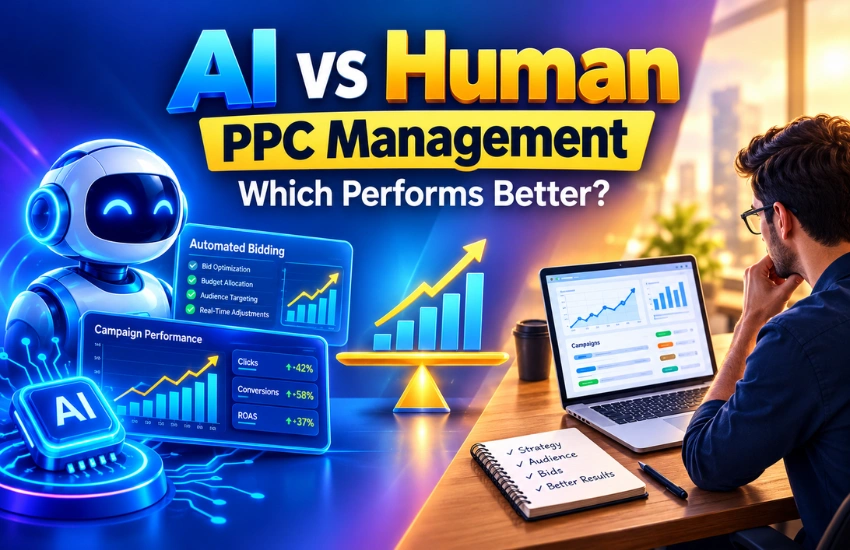
AI vs Human PPC Management: Which Performs Better?
Open Google Ads today and you’ll notice something: fewer manual levers, more suggestions. Smart Bidding sets your bids. Performance Max decides where your ads show up. Recommendations pop up asking you to accept broader targeting or new assets. Google has spent the last several years pushing automation and machine learning into nearly every corner of the platform – bidding, targeting, budget allocation, even ad copy.
That raises an obvious question for anyone running paid ads: if AI can analyze data and adjust campaigns automatically, do businesses still need a human PPC manager? This is where the AI vs human PPC management debate becomes important.
The short answer is that AI has become genuinely good at the mechanical, data-heavy parts of PPC – but “automated” is not the same as “strategically sound.” The two approaches aren’t really competing for the same job. Understanding where each one actually adds value is what separates campaigns that perform from campaigns that just run.
What Is AI-Powered PPC Management?
AI-powered PPC management uses machine learning, automation, and data-driven systems to help manage and optimize paid advertising campaigns.
In Google Ads, Smart Bidding can automatically set bids for individual auctions based on the likelihood of achieving a conversion or conversion value. Google’s broader AI changes are also reshaping how paid search campaigns work. See how AI Mode affects paid search.
It can evaluate a wide range of contextual signals and continuously update its predictions as campaign data changes.
Depending on the platform and tools being used, AI can assist with:
- Automated bidding
- Audience and targeting optimization
- Campaign performance analysis
- Budget and bid recommendations
- Search and query analysis
- Ad testing
- Performance forecasting
- Conversion optimization
- Identifying performance patterns
- Repetitive campaign tasks
The important distinction is that AI-powered PPC does not necessarily mean a campaign runs without human involvement. Much of the AI used in PPC is designed to automate specific tasks while marketers continue to set goals, provide inputs, monitor results, and make strategic decisions.
What Does Human PPC Management Involve?
It’s easy to reduce PPC management to “changing bids and budgets.” In practice, that’s a small part of the job.
An experienced PPC manager looks at the advertising campaign in the context of the entire business. They may consider the company’s goals, customers, competitors, pricing, sales process, landing pages, market conditions, and profitability before deciding what to change.
Human PPC management can include:
- Developing campaign strategy
- Researching keywords and audiences
- Understanding customer intent
- Analyzing competitors
- Creating positioning and messaging
- Planning budgets
- Reviewing search terms and traffic quality
- Testing landing pages and offers
- Interpreting campaign data
- Identifying problems that automation may not explain
- Coordinating PPC with SEO and content marketing
- Deciding which tasks should be automated
- Making strategic decisions when the available data is unclear
None of this shows up as a toggle in the interface. It’s the layer of thinking that determines what the automation should optimize for in the first place.
AI vs Human PPC Management: Key Differences
| Factor | AI-Powered PPC | Human PPC Manager |
|---|---|---|
| Data processing | Handles very large datasets almost instantly | Limited by time and manual review capacity |
| Speed | Adjusts bids and budgets in real time | Reacts on a daily or weekly review cycle |
| Automation | Executes repetitive tasks continuously | Sets up and monitors automation rules |
| Strategic thinking | Optimizes toward the goal it’s given | Defines what the goal should be |
| Business context | Limited to account-level signals | Understands margins, offers, and market position |
| Creative judgment | Generates and tests variations | Sets direction, tone, and brand fit |
| Pattern detection | Strong at spotting statistical trends | Strong at spotting why a trend is happening |
| Handling unexpected changes | Can lag during sudden market shifts | Can react to context AI doesn’t have |
| Scalability | Scales across accounts with minimal added effort | Scaling requires more time or team members |
| Emotional/customer understanding | Limited – works from behavioral data | Can interpret intent, tone, and positioning |
| Decision-making | Optimizes within set parameters | Sets the parameters and makes judgment calls |
| Cost considerations | Often lower direct cost, tool-based pricing | Higher cost, but includes strategic oversight |
Where AI Performs Better Than Humans
AI has a major advantage when the job involves processing large amounts of data quickly.
1. Processing Campaign Data
A PPC campaign can generate enormous amounts of information across searches, devices, locations, audiences, times, conversions, and other signals.
AI-powered systems can process these signals at a scale that would be difficult for a person to reproduce manually. Google’s Smart Bidding, for example, uses machine learning and multiple contextual signals to optimize bids at auction time.
2. Real-Time Optimization
Human PPC managers cannot realistically adjust a bid for every individual auction.
AI can.
Google describes Smart Bidding as auction-time bidding, meaning bids can be optimized for individual auctions based on the available signals and the campaign’s performance goals.
This makes AI particularly useful for campaigns operating at significant scale.
3. Repetitive Tasks
AI and automation are well suited to repetitive work.
Instead of spending hours performing routine adjustments, marketers can use automated systems to handle certain operational tasks and spend more time on strategy and analysis.
4. Pattern Recognition
AI can identify relationships and performance patterns across large datasets that may be difficult to spot manually.
For example, an automated system can evaluate many contextual signals simultaneously when estimating the likelihood of a conversion.
5. Scaling Campaigns
The larger a PPC account becomes, the more difficult manual optimization can be.
AI can help manage optimization at scale without requiring a person to manually evaluate every auction.
However, better automation does not automatically mean better business results. AI optimizes based on the goals, signals, conversion data, and constraints it receives. If those inputs are poor, automation may optimize toward the wrong outcome.
Where Human PPC Managers Still Perform Better
AI may be excellent at analyzing campaign data, but PPC performance is not determined by data alone.
1. Understanding Business Goals
Suppose a company wants more leads.
AI may be able to optimize toward a conversion goal. But a human still needs to ask:
Are these actually good leads?
Ten inexpensive leads are not necessarily better than three qualified leads that turn into paying customers. Poor campaign decisions can also lead to wasted ad spend. Learn why businesses lose money on Google Ads.
A human PPC manager can connect advertising performance with the company’s broader sales objectives.
2. Developing Strategy
AI can optimize within a defined framework, but businesses still need people to decide what they are trying to achieve.
Should the company focus on:
- Brand awareness?
- Qualified leads?
- Sales?
- Profitability?
- Market expansion?
- A particular product?
- A specific customer segment?
These strategic decisions influence how PPC campaigns should be structured and evaluated.
3. Understanding Customer Psychology
Numbers can show that one advertisement performs better than another.
But understanding why customers respond to a particular message can require broader market and customer knowledge.
Human marketers can consider factors such as customer concerns, motivations, objections, trust, brand perception, and buying behavior.
4. Handling Ambiguous Problems
Not every campaign problem has an obvious data-based solution.
Imagine conversions suddenly fall.
Possible causes could include:
- A competitor changing its offer
- A website problem
- A pricing change
- Poor lead quality
- Seasonal demand
- A change in the sales process
- A tracking issue
- A new customer behavior pattern
AI can identify that performance changed. A human may be needed to investigate why it changed and determine the appropriate response.
5. Connecting PPC With the Rest of Marketing
PPC does not operate in isolation.
An experienced marketer can connect paid advertising with:
- SEO
- Content marketing
- Landing pages
- Email marketing
- Social media
- Branding
- Sales
- Customer retention
That broader perspective can influence decisions that cannot be reduced to a single advertising metric.
Can AI Replace PPC Managers?
AI can replace some PPC tasks, but that does not mean it can automatically replace the entire role of a PPC manager. As advertising platforms become more automated, manual campaign management is changing.
PPC professionals may spend less time making repetitive bid adjustments and more time on:
- Strategy
- Data interpretation
- Testing
- Business alignment
- Campaign planning
- Creative direction
- Performance analysis
- AI oversight
In other words, the role is evolving.
Instead of competing with AI on tasks that machines are designed to perform efficiently, PPC professionals can use AI as an optimization and analysis layer while focusing on decisions that require context and judgment.
AI vs Human PPC Management: Which Is More Cost-Effective?
Cost-effectiveness depends on what’s being compared, and “cheaper” doesn’t always mean “more profitable.”
- Software and tool costs. AI-powered platforms and bidding tools typically cost less upfront than hiring a dedicated manager or agency.
- Management costs. Human oversight – whether in-house or agency – adds a direct cost, but that cost usually reflects strategic input, not just campaign monitoring.
- Time savings. Automation reduces the hours spent on manual, repetitive tasks, which can lower operational cost even when a human is still involved.
- Efficiency gains. Faster bid adjustments and broader testing can improve results over time, though this varies by account and industry.
- Cost of poor optimization. A campaign that’s technically “automated” but strategically misaligned can waste budget just as easily as one that’s manually mismanaged.
- Business complexity. A single-product account with a simple funnel has very different needs than a business with multiple offers, markets, or a long sales cycle.
- Campaign size. Larger budgets tend to justify more human oversight, since the cost of a strategic mistake scales with spend.
The cheapest setup on paper isn’t automatically the most profitable one. A low-cost, fully automated campaign that’s optimizing toward the wrong goal can end up more expensive than a professionally managed one – just in a less visible way.
What About AI + Human PPC Management?
For many businesses, the most practical approach may not be choosing between AI and humans at all. It may be using both.
AI can take care of tasks where automation has a clear advantage, while a human PPC manager provides strategy, oversight, and business context.
AI can help with:
- Data analysis across large volumes of signals
- Automated bidding within defined targets
- Repetitive, ongoing optimization
- Performance alerts and anomaly detection
- Assisting with creative and audience testing
Humans can handle:
- Overall strategy and campaign structure
- Defining business goals and success metrics
- Messaging, positioning, and creative direction
- Budget decisions, especially during uncertain periods
- Interpreting what the data actually means
- Oversight of what AI is optimizing toward
- Final decisions when the data is unclear or conflicting
Google itself describes its AI-powered advertising systems as tools that marketers can steer and adjust based on business needs. Its guidance notes that advertisers can adjust targets, budgets, and other campaign controls as goals or external circumstances change.
This highlights an important point: AI does not have to replace human PPC management to be valuable.
It can make human PPC management more efficient.
A Practical Example: AI + Human PPC Management
Imagine a local service business running Google Ads to generate leads.
The campaign receives plenty of clicks, and the automated bidding system continues optimizing toward conversions. AI identifies patterns in the account and adjusts bids based on the likelihood of conversion.
However, the business owner notices that the number of booked customers has not increased.
A human PPC manager investigates and discovers that many of the conversions being recorded are low-quality enquiries.
The problem is not necessarily the bidding strategy.
The problem is the definition of success.
The PPC manager may then recommend improving conversion tracking, changing the campaign’s targeting, refining ad messaging, reviewing the landing page, and aligning optimization with qualified leads rather than simply counting every enquiry.
Once the strategy is corrected, AI can continue helping with bidding and optimization. This illustrates the difference between optimizing a campaign metric and optimizing a business outcome.
Which PPC Management Approach Is Right for Your Business?
The right approach depends on your campaign size, goals, complexity, and internal expertise.
1. Small Business With a Simple Campaign: AI-powered automation can handle many routine optimization tasks, while periodic human review can help ensure that targeting, conversion tracking, and business goals remain aligned.
2. Growing Business: A combination of AI tools and active PPC management can provide a better balance between efficiency and strategic control.
3. Business With a Large Advertising Budget: When significant amounts of money are being invested in PPC, strategic oversight becomes increasingly important. AI can help with optimization and scale, while experienced professionals can focus on performance, profitability, and business objectives.
4. Highly Competitive Industry: Businesses competing in crowded markets may benefit from strong human strategy supported by AI-driven optimization.
5. Complex Sales Funnel: If a business has multiple conversion stages, long sales cycles, high-value customers, or complicated qualification processes, human oversight can be particularly valuable.
These are guidelines rather than fixed rules. The right setup depends on how your campaigns and business actually operate.
AI vs Human PPC Management: The Verdict
So, which performs better – AI or human PPC management?
There is no universal winner.
AI is exceptionally good at speed, scale, data processing, pattern recognition, and automated optimization. Modern Google Ads systems can use machine learning to evaluate contextual signals and optimize bids at auction time, capabilities that are difficult to reproduce manually.
Human PPC managers bring something different: strategy, business understanding, customer insight, creative judgment, and the ability to question whether the campaign is optimizing for the right outcome in the first place.
That is why the better question is not:
“Should we choose AI or a human?”
It is:
“Which parts of our PPC management should be automated, and which decisions require human judgment?”
For many businesses, AI can handle the repetitive and data-intensive work while humans focus on strategy and oversight. The strongest PPC approach may therefore be one where AI improves execution and humans remain responsible for direction.
The goal is not to make PPC management more automated for its own sake. The goal is to make advertising more efficient, more relevant, and more closely connected to business results.
Frequently Asked Questions
1. Can AI manage PPC campaigns without a human?
AI can automate many PPC tasks, but human oversight is still useful for strategy, goals, and performance review.
2. Is AI better than a PPC manager?
AI excels at data processing and automation, while human PPC managers excel at strategy and complex decisions.
3. Can AI replace Google Ads specialists?
AI can automate many tasks, but Google Ads specialists still provide strategy, analysis, and business-focused decisions.
4. What are the benefits of AI PPC management?
AI can process data quickly, optimize bids, identify patterns, and automate repetitive PPC tasks.
5. What can human PPC managers do that AI cannot?
Human PPC managers provide strategy, business context, customer insight, and creative judgment.
6. Should small businesses use AI for Google Ads?
Yes, AI can automate bidding and other tasks, but regular human review helps keep campaigns aligned with business goals.
7. Is human + AI PPC management better?
For many businesses, yes. AI handles repetitive tasks, while humans provide strategy and oversight.
Explore More Google Ads Insights:
👉 SEO vs Google Ads vs Social Media: Where to Start?
👉 Google Ads vs Meta Ads: Which is Better
👉 SEO vs Google Ads: Which Gets Faster Results
👉 Google Advertiser Verification: Complete Step-by-Step Guide