
GEO vs SEO: What’s the Difference and Which One Does Your Business Need?
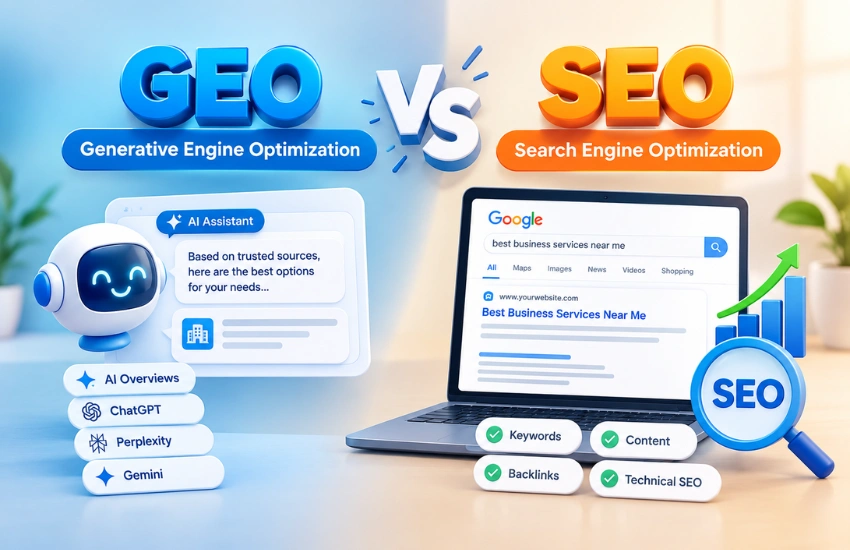
GEO vs SEO: What’s the Difference and Which One Does Your Business Need?
The way people search is changing. Alongside typing a query into Google, more people now ask AI tools directly – ChatGPT, Claude, Perplexity, Google’s AI Overviews, Gemini – to research businesses, compare products, and get quick answers to specific questions. That shift has introduced a new term into digital marketing conversations: GEO, or Generative Engine Optimization.
This isn’t limited to organic search either – we’ve already covered how Google’s AI Mode is reshaping paid search campaigns, and the same underlying shift is now raising questions for organic strategy too.
For business owners already investing in SEO, this raises an obvious question: GEO vs SEO: Is GEO a replacement for SEO, an extension of it, or something else entirely?
Short answer: SEO and GEO are related but not identical. SEO focuses primarily on visibility in traditional search engines. GEO focuses on making information more useful, understandable, authoritative, and discoverable within generative AI search experiences.
Neither one cancels the other out. This article breaks down GEO vs SEO, what each actually means, how they differ in practice, and how a business should think about prioritizing them.
What Is SEO?
Search Engine Optimization (SEO) is the practice of improving a website so it ranks higher in traditional search engine results – primarily Google and Bing. The goal is straightforward: when someone searches for something relevant to your business, your website should be easy to find.
SEO typically covers:
- Search visibility: Improving how easily your website can be discovered for relevant searches.
- Keyword and search-intent research: Understanding what people search for and what they are actually trying to accomplish.
- On-page SEO: Optimizing titles, headings, URLs, content, images, internal links, and other page elements.
- Technical SEO: Improving crawlability, indexability, site architecture, page speed, mobile usability, security, and other technical factors.
- Content quality: Creating accurate, useful, original, relevant, and comprehensive information.
- Topical authority: Building meaningful depth around the subjects, products, or services that matter to your business.
- Internal linking and website architecture: Connecting related information so both users and search engines can navigate the site more effectively.
- Link building and authority: Building credible references, mentions, and links from relevant and trustworthy websites.
- Structured data: Helping search engines understand important information about organizations, products, services, events, and other entities.
- Local SEO: Improving visibility in local search results, map listings, and location-based searches.
- User experience: Making the website easy to navigate, understand, and use across different devices.
- Conversion: Turning organic visibility into meaningful business actions such as calls, enquiries, bookings, purchases, or leads.
For example, imagine a dental clinic targeting the search:
“dentist in [city]”
The goal isn’t simply to place the phrase “dentist in [city]” on a webpage.
A stronger SEO strategy would include a technically healthy website, useful service pages, location information, relevant content, local business signals, credible references, internal linking, good user experience, and clear ways for potential patients to contact the clinic.
In simple terms:
SEO helps search engines discover, understand, evaluate, and rank your website so potential customers can find your business through traditional search.
What Is GEO?
Generative Engine Optimization (GEO) refers to the emerging practice of improving a brand’s content, information, authority, and online presence so that generative AI systems can better understand, retrieve, reference, summarize, and represent that information when generating answers.
This creates a different kind of search experience.
A traditional search might show:
10 blue links → user chooses a website → user reads the information.
A generative search experience may instead provide:
User question → AI researches or retrieves information → AI generates an answer → user may receive sources, citations, recommendations, or brand mentions.
For example, someone might ask:
“What should a small healthcare business look for when choosing a digital marketing agency?”
The AI system may generate an answer using information gathered from multiple sources.
For a business, visibility therefore isn’t limited to appearing as a blue link.
The business may also want its expertise, information, services, research, or brand to be understood, referenced, cited, or accurately represented when an AI system answers related questions.
GEO can involve several areas:
- Clear and direct answers: Answering the questions customers actually ask without unnecessary filler.
- Strong content structure: Using meaningful headings, definitions, examples, lists, tables, FAQs, and logical sections.
- Demonstrated expertise: Showing genuine knowledge and experience rather than repeating generic information.
- Topical authority: Covering important subjects comprehensively instead of publishing disconnected articles.
- Brand and entity signals: Clearly explaining who the business is, what it does, where it operates, and what it is known for.
- Consistent business information: Keeping important facts such as business name, services, locations, and contact information consistent across trusted sources.
- Credible references: Supporting important claims with reliable and checkable information.
- First-hand experience: Adding original research, case studies, examples, customer experiences, data, or expert insights.
- Fresh information: Keeping important information accurate and updated.
- Machine-readable information: Using appropriate technical structures and structured data where relevant.
- Multichannel authority: Building a credible presence across relevant websites, publications, directories, reviews, and other trusted sources.
- Factual accuracy: Making sure the information a business publishes about itself is clear, verifiable, and consistent.
One important point is often misunderstood:
GEO is not simply “writing content for ChatGPT.”
It is about building information that is useful to people and understandable to systems that generate answers.
There is also no guaranteed formula that makes ChatGPT, Gemini, Perplexity, or another AI system mention a particular business. GEO is still an emerging practice, and different AI platforms use different models, retrieval systems, data sources, and processes.
What businesses can control is the quality of their information, the authority of their brand, the consistency of their online presence, and how clearly they demonstrate expertise.
That is where GEO overlaps significantly with good SEO.
GEO vs SEO: What’s the Difference?
The table below breaks down how the two disciplines compare on the factors that matter most.
| Factor | SEO | GEO |
|---|---|---|
| Primary Goal | Organic search visibility | Visibility or citation inside generative AI answers |
| Main Environment | Traditional search engines (Google, Bing) | AI-powered search and answer tools (AI Overviews, ChatGPT, Perplexity, Gemini) |
| Content Focus | Search rankings and matching user intent | Clear, well-structured, authoritative information AI systems can interpret and reuse |
| Key Signals | Relevance, technical quality, authority, backlinks | Content clarity, authority, corroboration, entity signals — still evolving |
| Typical Outcome | Ranking position and click-through traffic | Mention, citation, or representation inside an AI-generated response |
| Maturity | Established, well-documented discipline | Emerging practice with evolving best practices |
One important caveat: no single factor – a schema tag, a statistic, a backlink – guarantees that an AI system will cite your content. GEO is directional guidance based on current patterns, not a formula with predictable outputs.
How Does GEO Work?
Because GEO practices are still evolving, it’s more useful to think in terms of principles than tactics. Businesses that want their content to be usable by generative AI systems generally focus on:
- Answering questions clearly and directly, rather than burying the answer in filler
- Demonstrating real expertise, not just repeating commonly available information
- Providing trustworthy, well-sourced information
- Structuring content logically – clear headings, scannable sections, defined terms
- Building topical authority by covering a subject thoroughly over time
- Strengthening brand and entity signals – consistent naming, clear “about” information, credible mentions elsewhere
- Supporting important claims with credible, citable sources
- Creating content that genuinely satisfies the underlying question, not just the keyword
There’s no reliable way to “optimize for ChatGPT” with a guaranteed formula, and any strategy that promises otherwise should be treated with skepticism. What businesses can control is the underlying quality, clarity, and trustworthiness of their content, which improves their odds in both traditional and AI-driven search.
For a more detailed, step-by-step breakdown of these practices, see our guide on how to rank for Google AI Overviews.
GEO vs SEO: Which One Does Your Business Need?
Most businesses aren’t choosing between SEO and GEO – they’re deciding where to focus first.
Choose SEO as the foundation if:
- Your website has weak organic visibility
- Your technical SEO needs improvement (speed, mobile experience, indexing)
- You have little genuinely useful content published
- Your business depends heavily on Google or Bing for discovery
- Your local search presence needs improvement
Invest more heavily in GEO-focused practices if:
- Your SEO foundation is already solid
- Your customers increasingly research complex questions through AI tools
- Your business relies on expertise and informational content
- You want your brand represented accurately when AI tools answer questions about your industry
The best approach for most businesses:
SEO + genuinely helpful content + strong authority + AI-search-friendly information. GEO builds on top of solid SEO fundamentals — it isn’t a shortcut around them.
How to Adapt Your SEO Strategy for AI Search
- Create genuinely useful content, not content written to satisfy an algorithm.
- Answer specific customer questions directly, in plain language.
- Strengthen topical depth instead of spreading thin across unrelated subjects.
- Demonstrate first-hand expertise where relevant – real experience, not generic advice.
- Make important information easy to understand at a glance.
- Build authoritative brand and entity signals across the web.
- Keep business information (name, services, location, contact details) consistent everywhere it appears.
- Support important claims with credible, checkable sources.
- Update outdated content instead of letting it sit stale.
- Continue investing in technical SEO – it still matters.
Example: SEO vs GEO for a Local Business
Consider a local digital marketing agency. The same business can – and should – optimize for both kinds of search behavior.
Traditional search: “best digital marketing agency in [city]” – the agency wants to rank well and appear in local results.
AI-assisted discovery: “What should a small business look for when choosing a digital marketing agency?” – here, the goal is for the agency’s published, well-structured advice to be the kind of content a generative engine finds credible enough to draw from when forming its answer.
Same expertise, two different discovery paths. A business that only optimizes for the first query is invisible in the second.
Does GEO Replace SEO?
No. GEO should not be treated as a replacement for SEO.
SEO remains important for search visibility, website discoverability, technical accessibility, and organic traffic. GEO-related practices address an additional discovery layer created by generative search – they don’t remove the need for the foundation SEO provides. Most current industry perspectives treat GEO as complementary to SEO, not a successor to it.
Common GEO and SEO Mistakes
- Treating GEO as a magic replacement for SEO fundamentals
- Publishing AI-generated content without adding real value or expertise
- Chasing AI mentions instead of improving underlying content quality
- Keyword stuffing, which helps neither traditional nor AI-driven search
- Writing solely for search engines or AI systems instead of the actual reader
- Making unsupported or exaggerated claims
- Ignoring technical SEO because GEO seems more current
- Losing sight of the actual customer and their real question
Not sure where your business stands on SEO or GEO readiness? We can audit your current search visibility and help you build a strategy that covers both traditional and AI-driven discovery – get in touch for a free consultation.
FAQs
What is the difference between GEO and SEO?
SEO focuses on visibility in traditional search engines like Google and Bing. GEO focuses on how content is understood, trusted, and potentially cited within AI-generated answers from tools like ChatGPT, Perplexity, and AI Overviews.
Is GEO replacing SEO?
No. Most current thinking treats GEO as complementary to SEO, building on the same foundations of quality, authority, and relevance rather than replacing them.
Is GEO the same as AEO?
They overlap. Answer Engine Optimization (AEO) is often used to describe optimizing for direct-answer features, while GEO is a broader term for optimizing for generative AI systems generally. Terminology is still settling across the industry.
Does GEO improve Google rankings?
Not directly. GEO is aimed at generative AI experiences rather than traditional ranking algorithms, though many of the same quality signals – clarity, authority, usefulness – benefit both.
How can a business optimize for AI search?
By publishing clear, well-structured, genuinely useful content that demonstrates real expertise and is supported by credible sources – the same fundamentals that support good SEO.
Does every business need GEO?
Not urgently. Businesses without a solid SEO foundation should prioritize that first. GEO becomes more relevant once core search visibility is already established.
Can SEO help with GEO?
Yes. Strong SEO fundamentals – authoritative content, technical health, credible signals – form the base that GEO efforts build on.
How long does GEO take to work?
There’s no fixed timeline, and because GEO practices are still evolving, results are less predictable than established SEO benchmarks. Consistent, high-quality content over time is the most reliable approach.
Conclusion
SEO and GEO shouldn’t be treated as an either/or decision. SEO builds the foundation for search visibility. GEO represents the evolving effort to make that same expertise and information useful and discoverable within generative search experiences.
The focus, either way, should stay on creating trustworthy, useful, well-structured content that serves the audience first – the discovery channel is secondary to that.