
How to Run Ads on ChatGPT: A Complete Step-by-Step Guide for Tour and Travel Companies
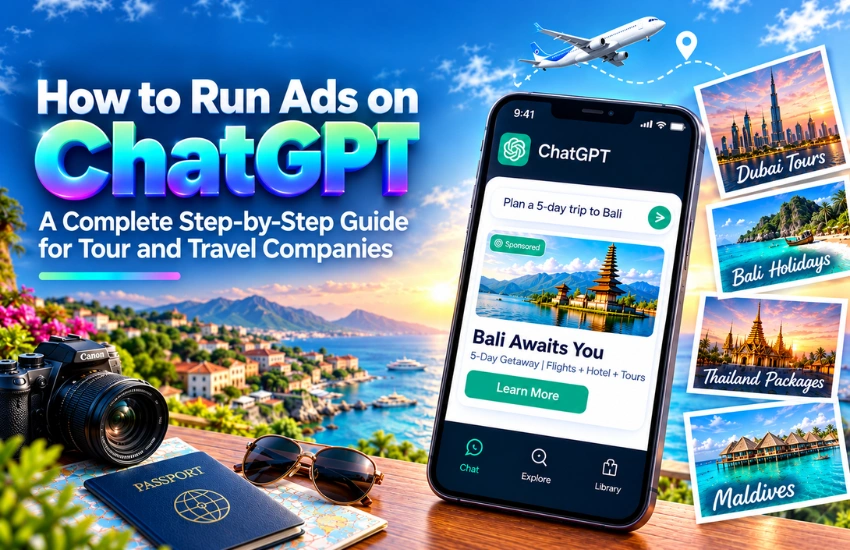
How to Run Ads on ChatGPT: A Complete Step-by-Step Guide for Tour and Travel Companies
magine a traveler planning a holiday to Dubai.
They open ChatGPT and ask:
“What are the best things to do in Dubai for a family of four?”
The conversation continues.
“Which water sports activities are worth booking?”
“Can you suggest a reliable tour operator?”
“Where can I find a good desert safari package?”
This is a different kind of customer journey from traditional search advertising. The person is not simply typing a keyword into Google. They are having a conversation, exploring options, comparing possibilities, and moving closer to a decision.
For tour and travel companies, this creates an interesting marketing opportunity.
What if your travel business could reach potential customers while they are actively planning their next trip?
That is where ChatGPT Ads come into the picture.
OpenAI has introduced advertising in ChatGPT and expanded its advertising program into additional markets, including India. The platform is designed to offer businesses a new way to reach people while they explore products and services. Read OpenAI’s official advertising announcement.
But how does ChatGPT advertising work? Can a travel agency run its own campaign? What kind of ads should a tour operator create? Which other industries can benefit?
This complete guide explains the opportunity, campaign setup process, travel-specific strategies, and practical considerations for businesses that want to explore advertising on ChatGPT.
What Are ChatGPT Ads?
ChatGPT Ads are sponsored advertisements displayed within the ChatGPT experience when a relevant sponsored product or service is available.
Unlike traditional search advertising, where users generally type keywords and receive a list of links, ChatGPT is a conversational environment.
A user might ask:
- “Find the best family holiday destinations.”
- “Where should I go for a honeymoon in December?”
- “What are the best adventure activities in Dubai?”
- “Help me plan a 5-day trip to Thailand.”
When advertising is available for a relevant conversation, a sponsored placement may appear separately from the AI-generated response.
OpenAI has stated that ads are clearly labeled and separated from organic answers. Its advertising principles also state that ads do not influence the answers ChatGPT provides.
For more information, visit OpenAI’s official advertising principles.
How ChatGPT Ads differ from Google Ads
Google Ads generally appear on search results pages when users search for particular keywords.
ChatGPT Ads are designed for a conversational environment where users may be researching, comparing, and exploring products or services.
For a travel business, the difference might look like this:
Google search:
“Dubai desert safari booking”
ChatGPT conversation:
“Which desert safari experience would you recommend for a family visiting Dubai?”
Both can represent valuable opportunities, but the customer’s journey and the way an advertisement fits into that journey are different.
This does not mean ChatGPT Ads will replace Google Ads. For most travel businesses, the better approach is to evaluate ChatGPT as an additional advertising channel alongside Google Search, Meta Ads, SEO, and other marketing activities.
Are ChatGPT Ads Available in India?
Yes, ChatGPT advertising has expanded into India.
OpenAI announced the expansion of its advertising program into India in August 2026. Contemporary reporting on the rollout stated that ads would initially be shown to eligible adult users on Free and Go plans, while Plus, Pro, Business, Enterprise, and Education users would continue to have an ad-free experience.
The rollout and account access may differ by market, account type, and stage of the advertising program.
Before planning a campaign, always verify current access through the official OpenAI advertising resources.
Useful resources:
Can every travel company advertise on ChatGPT?
Not necessarily.
Availability, eligibility, supported locations, account access, and campaign features can change as the platform develops.
If your business cannot access self-service advertising yet, you may need to check whether an agency or managed advertising route is available for your market.
Do not assume that every business in every country can immediately launch a campaign.
Why Tour and Travel Companies Should Explore ChatGPT Ads
Travel is a research-heavy industry.
Before booking a trip, customers often ask questions, compare destinations, look for activities, evaluate prices, and seek recommendations.
That makes conversational advertising particularly interesting for businesses that sell experiences and services.
1. Reach customers while they are planning a trip
A traveler may spend days or weeks researching a holiday before making a booking.
They might ask:
“What should I do in Dubai for three days?”
“Which water sports activities are best for beginners?”
“What are the best honeymoon destinations in Bali?”
“Can you recommend a family-friendly tour operator?”
These conversations can help businesses understand the questions customers ask before they are ready to purchase.
ChatGPT Ads may offer a way to introduce relevant services during that discovery process.
2. Promote experiences, not just destinations
Travel businesses do not only sell destinations.
They sell experiences.
For example:
- Desert safari
- Yacht rental
- Parasailing
- Jet ski rental
- Scuba diving
- City tours
- Honeymoon packages
- Family holidays
- Adventure activities
A travel advertisement can focus on the actual experience the customer wants to book.
Instead of simply promoting “Dubai,” an activity provider could promote a specific service such as a desert safari or private yacht tour.
3. Reach customers with specific interests
A person asking about luxury holidays has different needs from someone looking for a budget family vacation.
Similarly, a traveler searching for adventure activities may not be interested in a sightseeing package.
The opportunity for travel advertisers is to create relevant campaigns and landing pages for different customer needs.
4. Build another source of qualified traffic
Travel companies often rely on several marketing channels:
- Google Search Ads
- Meta Ads
- SEO
- Google Business Profile
- Social media marketing
- Travel marketplaces
- Referral marketing
ChatGPT Ads may become another channel to test.
The goal should not be to replace every existing channel immediately.
The goal should be to discover whether ChatGPT can generate qualified traffic and bookings at a commercially viable cost.
Step-by-Step Guide: How to Run Ads on ChatGPT
The following workflow is designed for businesses using the ChatGPT Ads platform.
Note: Advertising settings and availability can change. The exact screens, campaign options, and account requirements should be confirmed in the official Ads Manager when you create your campaign.
Step 1: Check your advertising eligibility
Start by visiting the officialOpenAI Ads website.
Check whether your business can access the advertising platform in your target market.
You may need to confirm:
- Business eligibility
- Supported country or region
- Account access
- Advertising permissions
- Billing availability
- Whether self-service campaign creation is available
If you are a travel agency based in India but targeting customers in the UAE, United States, United Kingdom, or Australia, make sure you understand which market and account settings apply to your campaign.
Do not confuse ChatGPT user availability with advertiser access. People being able to use ChatGPT in a country does not automatically mean every business can buy ads there.
Step 2: Create or access your Ads Manager account
If self-service advertising is available to your business, follow the official onboarding process.
Your account setup may involve business details, billing information, and advertising account permissions.
Before proceeding, make sure:
- Your business name is correct.
- Your website belongs to your business.
- Your billing details are accurate.
- Your landing page is working.
- Your business complies with applicable advertising requirements.
For a travel company, it is also a good idea to prepare your booking website before launching the campaign.
A paid advertisement should lead to a page where the customer can understand the offer and take the next step.
Step 3: Choose a clear campaign objective
A campaign objective determines what you want your advertising to achieve.
Depending on the options available in your account, you may be able to choose objectives such as:
- Reach
- Clicks
- Website traffic
- Conversions
For a tour and travel company, the most useful objective is often connected to a real business action.
For example:
Objective: Generate qualified booking inquiries.
Desired action: A customer visits the website and submits a booking request.
Alternative action: A customer clicks to contact the travel company through a booking or inquiry form.
Choose an objective based on your actual business goal rather than selecting an option simply because it sounds impressive.
Step 4: Set your budget
Your budget determines how much you are willing to spend on the campaign.
The correct starting budget depends on:
- Your target market
- Service price
- Competition
- Expected customer value
- Campaign objective
- Available advertising settings
- Your ability to track conversions
How much should a travel company spend?
There is no universal budget that guarantees results.
A company selling a $30 activity ticket may have very different economics from a company selling a $5,000 international holiday package.
For example:
Travel activity provider
Average booking value: $100
Target customer acquisition cost: $20
Luxury tour operator
Average booking value: $3,000
Target customer acquisition cost: $300
These figures are illustrative, not industry benchmarks. Your actual target should depend on your profit margin, repeat business, and conversion rate.
Start with a controlled test
A sensible approach is to begin with one campaign, one target audience, and one clear service.
Then measure:
- How many people click?
- How many submit inquiries?
- How many bookings result?
- What is the cost per qualified lead?
- What is the cost per booking?
- Is the campaign profitable?
Scale only after reviewing real performance.
What about the ₹725 daily budget?
Some reports published during the August and September 2026 Indian rollout mentioned a minimum daily spend of approximately ₹725 for self-service advertising.
Because this is a current platform detail that may change, do not present it as a permanent or universal minimum.
Always verify the actual budget requirements inside your account before publishing or planning a campaign.
Step 5: Select your campaign audience and context
The right audience matters more than simply reaching a large number of people.
A Dubai water sports company may want to reach people interested in:
- Dubai holidays
- Water sports
- Adventure activities
- Family travel
- Beach vacations
- Luxury experiences
A honeymoon travel agency may focus on:
- Romantic holidays
- Honeymoon destinations
- Luxury resorts
- International travel
- Couple-friendly experiences
Depending on the platform’s available settings, advertisers may be able to use campaign context or other audience-related controls.
The important principle is to make your campaign relevant to the service you are promoting.
Do not assume that selecting a topic guarantees your ad will appear for every related question.
Step 6: Create your travel advertisement
This is where your campaign becomes visible to potential customers.
A good travel advertisement should answer three questions quickly:
- What experience are you offering?
- Why should the customer consider it?
- What should they do next?
Example: Dubai desert safari ad
Headline:
Book Your Dubai Desert Safari
Description:
Discover an unforgettable desert experience with exciting dune adventures, beautiful sunset views, and Arabian hospitality. Explore our safari packages and plan your Dubai adventure today.
Call to action:
Explore Safari Packages
Landing page:
Your dedicated Dubai desert safari booking page.
Example: Dubai water sports ad
Headline:
Explore Dubai Water Sports
Description:
Ready for an unforgettable adventure? Discover jet ski rides, parasailing, and exciting water activities in Dubai. Check available experiences and plan your next adventure.
Call to action:
Explore Water Sports
Landing page:
Your water sports activities page.
Example: Family holiday packages
Headline:
Plan Your Next Family Holiday
Description:
Discover family-friendly destinations, exciting activities, and travel packages designed for unforgettable holidays. Explore your options and start planning today.
Call to action:
Explore Holiday Packages
Landing page:
Your family holiday packages page.
Travel ad writing tips
Keep your ad:
- Clear
- Relevant
- Easy to understand
- Focused on one offer
- Honest about what is included
- Consistent with the landing page
Avoid vague claims such as:
“Best travel company in the world.”
“Guaranteed cheapest holiday.”
“Number one tour operator.”
Unless you can substantiate a claim, do not use it.
A clear and believable offer is usually more useful than exaggerated advertising language.
Step 7: Choose the right landing page
One of the biggest mistakes travel businesses make is sending every advertisement to their homepage.
A customer interested in a desert safari should not have to search through your entire website to find the safari package.
Instead, send them to the most relevant page.
Examples
| Advertisement | Recommended Landing Page |
|---|---|
| Dubai desert safari | Desert safari booking page |
| Jet ski rental | Jet ski rental page |
| Parasailing | Parasailing activity page |
| Honeymoon packages | Honeymoon package page |
| Family holiday | Family holiday package page |
| Hotel booking | Relevant hotel booking page |
A good landing page should include:
- Clear service title
- Attractive, relevant images
- Service details
- Pricing or starting price where appropriate
- Available dates or booking options
- Customer reviews where genuine
- FAQs
- Contact or booking form
- Clear call to action
Example landing page CTA
Ready to Book Your Dubai Adventure?
Check availability, explore our packages, and send us your booking inquiry.
[Request a Quote]
The customer should know exactly what to do next.
Step 8: Add tracking before launching
This is one of the most important steps.
A campaign may generate clicks, but clicks alone do not tell you whether the campaign is profitable.
You need to track meaningful actions.
For a travel company, these might include:
- Booking form submissions
- Contact form submissions
- Phone calls
- WhatsApp inquiries
- Package purchases
- Hotel bookings
- Tour reservations
Use UTM tracking
A UTM-tagged URL can help identify traffic from a specific campaign.
For example:
https://example.com/dubai-desert-safari/?utm_source=chatgpt&utm_medium=paid&utm_campaign=dubai_desert_safari
This is an illustrative tracking URL. Replace the domain and campaign values with your actual website details.
You can then review traffic and conversions in your analytics platform.
Track real bookings, not just clicks
Suppose your campaign produces:
- 1,000 clicks
- 50 inquiries
- 5 bookings
That tells you much more than simply reporting 1,000 clicks.
You can calculate:
Conversion rate
5 bookings ÷ 1,000 clicks × 100 = 0.5%
Cost per booking
Total ad spend ÷ 5 bookings
These are illustrative calculations. Your actual performance will depend on your campaign.
Step 9: Review and launch your campaign
Before launching, review the complete campaign.
Campaign checklist
- Correct business name
- Correct target market
- Relevant campaign objective
- Appropriate budget
- Clear headline
- Accurate ad description
- Working landing page
- Tracking parameters added
- Booking form tested
- Contact details verified
- Advertising policy compliance checked
Once everything is ready, launch the campaign using the options available in your Ads Manager.
Do not assume the campaign will immediately produce bookings.
Give it time to collect data, then review performance and make informed adjustments.
How to Create High-Performing ChatGPT Ads for Travel Businesses
Launching a campaign is only the beginning.
The quality of your offer, landing page, and customer experience can have a major impact on the results.
1. Promote one experience at a time
A common mistake is trying to advertise every service in one ad.
For example:
“Desert Safari, Yacht Rental, Jet Ski, Parasailing, City Tour, Hotel Booking, Airport Transfer, and More.”
This may be too broad.
Instead, create separate campaigns for separate services.
Campaign A: Dubai Desert Safari
Campaign B: Dubai Water Sports
Campaign C: Dubai Yacht Rental
This makes it easier to understand which service is attracting customers.
2. Use specific travel offers
A specific offer is often easier to understand than a generic advertisement.
Examples:
- Sunset desert safari
- Private yacht rental
- Family-friendly Dubai tour
- Half-day city sightseeing
- Honeymoon package
- Airport transfer with hotel booking
Only advertise offers that your business genuinely provides.
3. Focus on customer questions
Think about what customers ask before booking.
For a Dubai activity company:
“What are the best water sports activities in Dubai?”
“Is parasailing suitable for beginners?”
“How much does jet ski rental cost in Dubai?”
“What should I know before booking a desert safari?”
These questions can help you create better landing pages, FAQs, and advertising messages.
4. Use destination-specific landing pages
A travel business serving multiple destinations should create relevant pages for each destination.
For example:
- Dubai Tours
- Abu Dhabi Tours
- Bali Holidays
- Thailand Packages
- Maldives Honeymoon Packages
This helps customers find the information they need without navigating an unrelated website.
5. Make booking easy
Travel customers often compare several options before deciding.
If your booking process is confusing, you may lose potential customers even after paying for the click.
Make sure your website is:
- Mobile-friendly
- Fast enough
- Easy to navigate
- Clear about pricing
- Easy to contact
- Easy to book
A good advertisement cannot compensate for a poor booking experience.
Other Industries That Can Benefit From ChatGPT Ads
ChatGPT advertising is not limited to travel companies.
Many industries may benefit from advertising in a conversational environment, especially businesses whose customers research options before taking action.
The opportunity is strongest when there is a clear customer need, a relevant offer, and a landing page that supports conversion.
1. Hotels and Resorts
Hotels can promote:
- Accommodation packages
- Weekend stays
- Luxury resorts
- Family-friendly hotels
- Honeymoon stays
- Business travel accommodation
Example customer question
“What are the best luxury resorts in Goa for a weekend getaway?”
A relevant hotel or resort advertisement could introduce a suitable package.
Best landing page: Hotel booking or accommodation package page.
2. Restaurants and Food Businesses
Restaurants can promote:
- Dining experiences
- Private dining
- Catering
- Special menus
- Event dining
- Restaurant reservations
Example customer question
“Where can I find a good restaurant for a family dinner?”
Restaurants with clear menus, location information, and booking options may benefit from relevant advertising.
Best landing page: Menu, reservation, or restaurant website.
5. Software and SaaS Companies
Software companies can promote:
- CRM software
- Accounting software
- Marketing automation
- Project management tools
- Business analytics
- AI tools
Example customer question
“What is the best CRM for a small business?”
A software company may benefit from introducing its product to someone actively researching solutions.
Best landing page: Product page, free trial, or demo booking page.
Apart from these, there are several industries that can be benefited by running Ads on ChatGPT.
Which Industries Are Most Suitable for ChatGPT Ads?
Not every business will benefit equally.
The strongest candidates are generally businesses where customers:
- Research before buying.
- Compare several options.
- Ask questions about products or services.
- Have a clear commercial need.
- Can take a measurable action after visiting the website.
Potentially strong categories
| Industry | Why It May Benefit |
|---|---|
| Tour and travel | Customers research destinations and activities |
| Hotels and resorts | Customers compare accommodation options |
| SaaS | Businesses research tools and solutions |
These are opportunities to test, not guaranteed results.
The right fit depends on customer behavior, ad availability, competition, budget, and conversion performance.
ChatGPT Ads vs Google Ads vs Meta Ads
A travel company may wonder whether ChatGPT Ads should replace its existing advertising channels.
In most cases, that is not the right question.
A better question is:
Which channel helps us reach the right customers at an acceptable cost?
Google Ads
Google Ads can be valuable for capturing customers who are actively searching for a service.
Example:
“Dubai desert safari booking”
Strength: High-intent search traffic.
Meta Ads
Facebook and Instagram advertising can be useful for visual travel inspiration, retargeting, and reaching audiences based on available targeting options.
Example:
A video showing a desert safari experience.
Strength: Visual discovery and audience-based advertising.
ChatGPT Ads
ChatGPT Ads provide an opportunity to test advertising in a conversational AI environment.
Example:
A customer asks about the best Dubai adventure activities.
Strength: Reaching users during conversational research and decision-making.
The best approach
For many travel businesses, a combined strategy may be more effective than relying on one channel.
For example:
- Google Ads for high-intent booking searches
- Meta Ads for travel inspiration and retargeting
- SEO for long-term organic visibility
- ChatGPT Ads for testing AI-based advertising opportunities
Each channel should be evaluated based on actual performance.
How to Measure the Success of ChatGPT Ads
The purpose of advertising is not simply to generate impressions.
It is to support business growth.
For a tour and travel company, track the following.
1. Impressions
How many times was your advertisement shown?
This helps you understand campaign reach.
2. Clicks
How many people clicked the advertisement?
This tells you whether the ad is attracting traffic.
3. Click-through rate
CTR measures the percentage of impressions that result in clicks.
CTR = Clicks ÷ Impressions × 100
For example:
1,000 impressions and 30 clicks produce a 3% CTR.
This is an illustrative calculation, not a travel-industry benchmark.
4. Cost per click
How much are you paying for each click?
CPC = Total ad spend ÷ Clicks
5. Conversion rate
How many visitors complete a desired action?
Conversion rate = Conversions ÷ Clicks × 100
6. Cost per lead
How much does it cost to generate a qualified inquiry?
Cost per lead = Total ad spend ÷ Qualified leads
7. Cost per booking
For a travel company, this is often one of the most important metrics.
Cost per booking = Total ad spend ÷ Number of bookings
8. Return on advertising spend
ROAS measures revenue generated relative to advertising spend.
ROAS = Attributed revenue ÷ Ad spend
For example, if a campaign generates ₹1,00,000 in attributed revenue from ₹20,000 in ad spend, the ROAS is 5.
This does not mean the campaign is automatically profitable. Profitability also depends on costs, margins, refunds, and the quality of bookings.
Common Mistakes to Avoid
Mistake 1: Expecting instant bookings
A new advertising channel may need testing and optimization.
Do not assume every campaign will produce bookings immediately.
Mistake 2: Sending traffic to the homepage
Use a landing page relevant to the advertised service.
Mistake 3: Advertising every service in one campaign
Start with one clear offer.
Mistake 4: Ignoring tracking
Without conversion tracking, you may not know whether your campaign is generating real business.
Mistake 5: Making unsupported claims
Avoid promises such as:
- Guaranteed bookings
- Guaranteed #1 placement
- Guaranteed lowest price
- Guaranteed travel experience
- Guaranteed customer satisfaction
Use accurate, verifiable claims instead.
Mistake 6: Ignoring advertising policies
Travel, finance, healthcare, and other industries may have specific requirements.
Always review the current platform rules before launching.
Is ChatGPT Ads Right for Your Travel Business?
ChatGPT Ads may be worth testing if your business has:
- A clear travel service
- A reliable website
- A relevant landing page
- A measurable booking or inquiry process
- A defined advertising budget
- A target audience
- A willingness to test and optimize
It may be less suitable if your business:
- Has no working website
- Cannot track inquiries or bookings
- Has no clear offer
- Cannot respond to customer inquiries quickly
- Expects guaranteed results without testing
- Has no budget for campaign experimentation
A new channel should be evaluated on its ability to contribute to your business goals.
How WEBOPTECH Can Help Travel Businesses Explore AI Advertising
The digital advertising landscape is changing.
Customers are discovering businesses through search engines, social media, maps, and AI-powered platforms.
For tour and travel companies, this creates opportunities to reach customers at different stages of the booking journey.
At WEBOPTECH, we help businesses explore digital marketing strategies focused on visibility, qualified traffic, and lead generation.
Our services include:
- Performance Marketing
- Google Ads
- Meta Ads
- SEO
- Local SEO
- AEO
- GEO and AI Search Visibility
- Google Business Profile optimization
- Website and landing page optimization
For travel businesses, a well-planned campaign may combine paid advertising with strong destination content, relevant landing pages, and a reliable booking experience.
The goal is not to advertise everywhere. The goal is to identify the channels that help your business reach the right customers and generate measurable growth.
Ready to Explore ChatGPT Ads for Your Travel Business?
Whether you operate a travel agency, tour company, hotel, or activity business, we can help you evaluate your advertising opportunities and develop a strategy aligned with your goals.
Request a Digital Marketing Proposal from WEBOPTECH
You can also explore our SEO services and learn more about WEBOPTECH.
Frequently Asked Questions
What are ChatGPT Ads?
ChatGPT Ads are sponsored advertisements displayed within ChatGPT when a relevant sponsored product or service is available. OpenAI says ads are clearly labeled and separate from the AI-generated answer.
Can travel agencies run ads on ChatGPT?
Eligible travel agencies may be able to advertise through the ChatGPT Ads platform. Availability depends on the market, account eligibility, and current advertising access.
Are ChatGPT Ads available in India?
ChatGPT advertising has expanded into India. Advertisers should check the current official OpenAI Ads resources to confirm access and available campaign options.
How much does it cost to advertise on ChatGPT?
The cost depends on the available campaign settings, bidding options, budget, and competition. Confirm current pricing and minimum budget requirements inside Ads Manager.
Can I advertise Dubai tours on ChatGPT?
If your business and campaign are eligible, you may be able to promote Dubai tours, desert safaris, water sports, and other travel services. Use relevant landing pages and accurate advertising claims.
Can ChatGPT Ads guarantee bookings?
No advertising channel can guarantee bookings. Campaign performance depends on factors such as audience relevance, offer quality, website experience, competition, and conversion rate.
Which other industries can benefit from ChatGPT Ads?
Potentially suitable industries include hotels, restaurants, real estate, education, SaaS, e-commerce, automotive, B2B manufacturing, and other businesses whose customers research options before purchasing.
Should ChatGPT Ads replace Google Ads?
Not necessarily. ChatGPT Ads should be evaluated as an additional channel. Google Ads, Meta Ads, SEO, and other marketing channels may continue to play important roles in a travel company’s customer acquisition strategy.
Final Thoughts
ChatGPT is creating new opportunities for businesses to reach customers through conversational experiences.
For tour and travel companies, this is especially interesting because travel customers often research, compare, and plan before booking.
A well-executed ChatGPT Ads campaign may help your business reach potential customers during those moments of discovery.
But the most important principle remains the same:
Do not focus only on getting your advertisement seen. Focus on reaching the right customers, offering something valuable, and turning interest into measurable business results.
Start with a clear service. Build a relevant landing page. Set a realistic budget. Track inquiries and bookings. Test your campaign. Learn from the data.
That is how businesses can approach ChatGPT advertising with a practical and sustainable marketing strategy.