
AI Agents vs AI Chatbots: What Marketers Need to Know
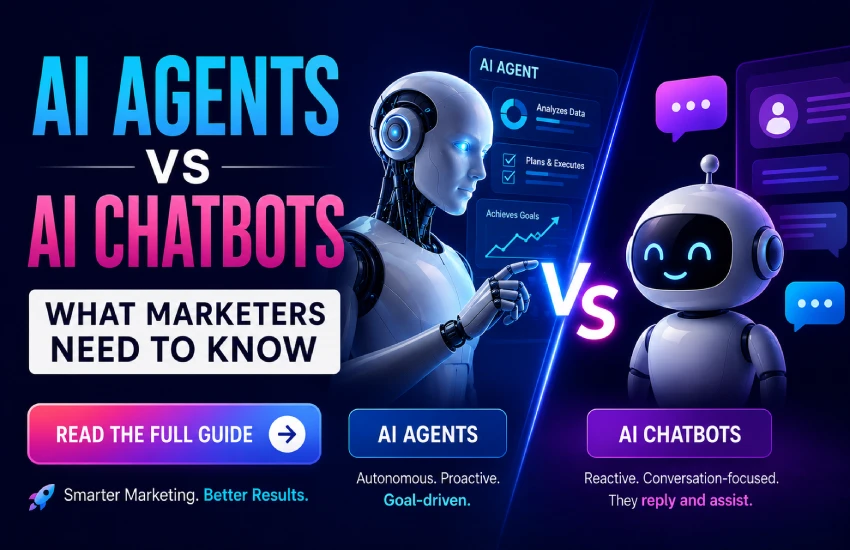
AI Agents vs AI Chatbots: What Marketers Need to Know
AI has already changed how marketers create content, answer customer questions, analyze data, and manage campaigns. But a new shift is happening: AI is moving from simply responding to instructions to taking action and completing tasks on its own.
As a digital marketer, I’ve seen firsthand how quickly AI is evolving from a tool for individual tasks into a part of larger marketing workflows.
That is where AI agents come into the picture.
If you are already using an AI chatbot for customer support, lead generation, or website conversations, you may be wondering: what is the actual difference between an AI agent and an AI chatbot, and does your marketing team need one?
The short answer is that they serve different purposes.
An AI chatbot is primarily built for conversation. An AI agent goes further – planning tasks, using connected tools, making decisions within defined boundaries, and completing multi-step workflows. Google Cloud describes AI agents as systems that can reason, plan, use tools, and act toward a goal, while chatbots are generally focused on conversational interaction.
For marketers, understanding this difference matters because the right technology depends on the job you want AI to perform.
What Is an AI Chatbot?
An AI chatbot is software designed to communicate with people through a conversational interface.
A visitor might ask, “What services do you offer?” and the chatbot understands the question and provides an appropriate answer. More advanced chatbots can also handle follow-up questions, recommend products or services, collect contact information, and help users complete specific tasks.
For example, a digital marketing agency could use a chatbot on its website to:
- Answer common service questions
- Explain SEO or Google Ads services
- Collect lead information
- Help visitors find the right service
- Provide basic pricing information
- Schedule or request a consultation
- Route complicated questions to a human team member
The important point is that the conversation is central to the chatbot’s role.
Large language models, knowledge bases, retrieval systems, and integrations with other software can power AI chatbots. However, not every chatbot has the ability to independently plan and execute complex workflows.
What Is an AI Agent?
An AI agent is designed to pursue a goal and take actions to achieve it.
Instead of simply answering a question, an AI agent can determine what to do next, select appropriate tools, retrieve information, perform actions, evaluate the results, and continue until the assigned task is complete. Google Cloud describes AI agents as systems capable of reasoning, planning, memory, decision-making, and action.
For marketers, imagine giving an AI system a goal such as: “Find our highest-performing Google Ads campaigns from the last 30 days and identify where we are wasting budget.”
A sufficiently connected AI agent could potentially:
- Access campaign data.
- Analyze spending and conversion information.
- Identify unusual performance changes.
- Compare campaigns.
- Find potential budget inefficiencies.
- Prepare recommendations.
- Create a report for the marketing team.
The difference is not simply that the agent can “talk better.”
The bigger difference is its ability to reason through a workflow and take actions using connected tools.
AI Agents vs AI Chatbots: The Key Difference
The simplest way to understand the difference is this:
- AI chatbots are primarily conversation-oriented. AI agents are goal-oriented and action-oriented.
- An AI chatbot generally waits for a user request and responds.
- An AI agent can be given a goal and may determine the steps required to accomplish it.
| Feature | AI Chatbot | AI Agent |
|---|---|---|
| Primary purpose | Conversation and assistance | Completing goals and tasks |
| Interaction | Mostly reactive | Can be proactive |
| Decision-making | Usually limited | More advanced |
| Multi-step workflows | Limited or predefined | Designed for complex workflows |
| Tool usage | May use integrations | Can select and use tools |
| Autonomy | Lower | Higher |
| Marketing use | Customer support, FAQs, lead capture | Campaign analysis, automation, workflow execution |
| Human involvement | Often required for next steps | Can require less intervention |
The boundary is not always absolute. Modern AI systems increasingly combine chatbot interfaces with agentic capabilities, so a single product can behave like both a chatbot and an agent depending on how it is built. IBM also notes that the distinction between chatbots and agents is becoming less clear as platforms combine conversational and autonomous capabilities.
Where Chatbots Help Marketers
AI chatbots remain extremely useful for marketing.
In fact, businesses should not assume that every marketing problem requires an AI agent.
1. Website Lead Generation
A chatbot can engage visitors when they are browsing your website.
For example:
Visitor: “Do you provide SEO services for small businesses?”
Chatbot: “Yes. We help businesses improve organic visibility through SEO strategies. Would you like to learn about our SEO services or request an audit?”
This creates an immediate conversation without requiring a salesperson to respond manually.
2. Customer Support
Chatbots handle repetitive questions about services, products, business hours, delivery, policies, and appointments, reducing manual workload.
3. Lead Qualification
A chatbot can ask about business type, service interest, budget, and goals, then pass the answers to sales or marketing.
4. Product or Service Recommendations
A chatbot can help users navigate choices.
Someone looking for digital marketing services might ask:
“Should I invest in SEO or Google Ads?”
The chatbot can ask about their goals, timeline, competition, and budget before providing general guidance.
Where Agents Can Help Marketers
AI agents become more interesting when the task extends beyond conversation.
IBM describes marketing applications for AI agents across areas such as customer engagement, content creation, campaign management, performance analysis, SEO, email marketing, and social media.
Here are some practical examples.
1. Campaign Performance Analysis
Instead of asking an AI tool to summarize a spreadsheet manually, a connected marketing agent could potentially retrieve campaign data, analyze performance, identify anomalies, and generate recommendations.
For example:
Goal: “Find campaigns with declining conversion rates and explain why.”
The agent could analyze multiple data points and produce a prioritized list for the marketing team.
2. SEO Monitoring
An AI agent could potentially monitor selected SEO metrics and workflows.
For example, it could:
- Check ranking changes
- Identify pages losing organic visibility
- Review technical issues
- Compare recent performance
- Identify content gaps
- Prepare an optimization report
Human review would still be important before making significant changes.
3. Content Workflows
A marketing agent could potentially coordinate several stages of a content workflow.
For example:
Topic research → keyword analysis → content brief → draft → internal-link suggestions → content review → publishing workflow
Instead of asking AI to perform each step separately, an agentic system could coordinate multiple stages.
That is a significant change in how marketing teams may use AI.
4. Paid Advertising
Agents could eventually monitor performance, identify underperforming areas, recommend changes, and – with the right permissions and safeguards – make selected adjustments.
This is particularly important as advertising platforms themselves are becoming increasingly AI-driven. We have already covered how Google’s AI Mode is changing paid search, making this topic a natural extension of that discussion.
5. Personalized Customer Journeys
An agent could potentially connect information from CRM systems, website activity, customer interactions, and marketing platforms to determine what action should happen next.
For example:
A customer downloads an ebook → the system identifies their interests → checks previous interactions → determines the appropriate follow-up → sends a personalized message → updates the CRM.
That goes beyond simply answering a chatbot question.
AI Chatbot vs AI Agent: A Simple Marketing Example
Imagine someone visits a digital marketing agency website and asks:
“Can you help my business get more leads?”
With an AI chatbot:
The chatbot might:
- Explain the available services and help the visitor understand how the business can help.
- Ask basic questions about the business to understand the visitor’s needs and identify the most relevant service.
- Provide general recommendations based on the information shared during the conversation.
- Collect lead information, such as the visitor’s name, email address, phone number, business name, and service requirements.
- Answer common questions about services, pricing, processes, availability, or other frequently requested information.
- Qualify the lead by asking predefined questions about business needs, budget, timeline, or goals.
- Schedule or request a consultation by directing the visitor to an available booking option or passing the request to the sales team.
- Send the lead to the appropriate team member for further discussion or follow-up.
The key point is that the chatbot primarily facilitates the conversation, provides information, and captures or qualifies the lead. More complex analysis, strategic planning, cross-platform data access, and multi-step task execution may require an AI agent.
With an AI agent:
An AI agent could potentially go beyond answering the visitor’s questions and work toward a defined business goal. With the appropriate permissions, integrations, and human oversight, it could:
- Understand the business objective and clarify what the business is trying to achieve, such as increasing leads, improving online visibility, generating sales, or reducing customer acquisition costs.
- Ask relevant, goal-oriented questions about the business, target audience, current marketing activities, budget, challenges, competition, and expected outcomes.
- Access permitted business information from connected systems such as the website, CRM, analytics platforms, advertising accounts, or other approved data sources.
- Analyze available marketing data to understand current performance, identify trends, and evaluate what is working and what may need improvement.
- Identify potential opportunities based on the business goals, available data, customer journey, market conditions, and current marketing performance.
- Schedule a consultation with the business owner or decision-maker to discuss the business in greater detail, validate the findings, and understand priorities that may not be visible in the available data.
- Recommend a tailored marketing strategy based on the business objectives, conversation, available data, and identified opportunities.
- Create a preliminary action plan outlining potential priorities, recommended channels, key activities, and possible next steps for the marketing team.
- Update the CRM with relevant business information, qualification details, conversation notes, recommendations, and agreed next steps.
- Trigger appropriate follow-up workflows, such as sending a confirmation email, assigning tasks to the sales or marketing team, starting a nurture sequence, or scheduling a follow-up reminder.
The important distinction is that the agent is not simply answering, “Can you help my business get more leads?” It could potentially take the conversation further by understanding the business, gathering the information required to evaluate the situation, coordinating the next step with the business owner, and helping move the opportunity into a structured marketing workflow.
It is conversation vs goal-driven execution.
Do You Need a Chatbot or an Agent?
There is no universal answer – It depends on the complexity of the problem.
Choose an AI chatbot when you need:
- Website conversations
- Customer FAQs
- Lead capture
- Basic customer support
- Product or service guidance
- Simple qualification
- 24/7 conversational assistance
Consider an AI agent when you need:
- Multi-step automation
- Data analysis across multiple systems
- Complex marketing workflows
- Automated task execution
- Campaign monitoring
- Cross-platform processes
- Repetitive decision-based workflows
For many small businesses, a well-designed chatbot may provide more practical value than an advanced agent.
There is little reason to introduce an autonomous system when the business only needs a tool to answer ten common customer questions.
A Practical AI Strategy for Marketing Teams
If your business is considering AI agents, start small – don’t try to automate the entire marketing department at once.
Step 1: Identify repetitive workflows: Look for tasks that consume time every week.
Step 2: Separate conversation from execution: If a task only needs an answer, a chatbot may be enough. If it needs planning and execution across systems, consider an agent.
Step 3: Start with low-risk tasks: Begin with reporting, research, or content organization before giving AI control over high-impact customer or advertising decisions.
Step 4: Connect only necessary tools: Don’t grant access to every marketing platform just because integrations exist – limit permissions to what the workflow actually requires.
Step 5: Keep humans involved: For important decisions – especially advertising budgets, customer communication, publishing, pricing, and brand reputation – human review can remain essential.
The Bottom Line
AI chatbots and AI agents are not interchangeable technologies.
Chatbots are built to communicate and assist – they remain valuable for customer conversations, lead generation, FAQs, and support. Agents are built to pursue goals, reason through tasks, use tools, and act with greater autonomy – useful when workflows involve multiple steps, systems, and decisions.
The most effective strategy isn’t choosing one over the other. It’s identifying which parts of your customer journey need conversation, which need automation, and which still require human judgment.
Not sure whether your business needs a chatbot, an agent, or both? Our team can help you map your marketing workflows and design the right setup – get in touch for a free consultation.
FAQs
Are AI agents better than AI chatbots for marketing?
Not always. AI chatbots are often better for customer conversations, FAQs, lead capture, and basic support. AI agents are more suitable for complex, multi-step workflows that require planning, tool usage, and action.
What is the main difference between an AI agent and an AI chatbot?
The main difference is autonomy and task execution. An AI chatbot primarily responds to conversations, while an AI agent can work toward a defined goal by planning steps, using tools, making decisions, and taking actions.
Can an AI chatbot become an AI agent?
Yes, depending on how the system is designed. A chatbot interface can be connected to an agentic system that uses tools, data, memory, and workflows to perform actions beyond conversation.
How can AI agents help digital marketers?
AI agents can potentially assist with campaign analysis, SEO monitoring, content workflows, customer engagement, reporting, lead management, and other multi-step marketing processes.
Will AI agents replace marketing teams?
AI agents are more likely to automate parts of marketing workflows than eliminate the need for marketing teams entirely. Strategy, creativity, brand judgment, customer understanding, and oversight remain important.
Should a small business use an AI agent?
Not necessarily. A small business should first identify the problem it wants to solve. If the need is simple customer support or lead capture, an AI chatbot may be sufficient. More complex workflows may justify an AI agent.
Are AI agents expensive?
The cost varies significantly depending on the model, integrations, infrastructure, usage, and level of automation. Businesses should evaluate the cost against the specific workflow being automated rather than assuming an AI agent is automatically more valuable.